
Ask, analyze, explain
Answer questions, analyze situations, explain decisions, summarize context, and support image-based diagnostic workflows.
Greg is The Hidden Canopy's community-facing assistant: a DeepSeek-backed language engine paired with IDA family convergence and practical workflows for diagnostics, cultivation, governance, economy, community, and operations.
Greg is a community and operator surface, not a shadow RegOS. It can explain, coordinate, diagnose, and render advisory outcomes. It does not own deterministic authority, turn social reputation into regulated trust, or treat every community conversation as training data.
Greg uses an external language model for generation, then routes the question through an IDA family convergence process. The family brings different perspectives to the same request, preserves meaningful disagreement, checks uncertainty, and produces a more deliberate answer for the surface.
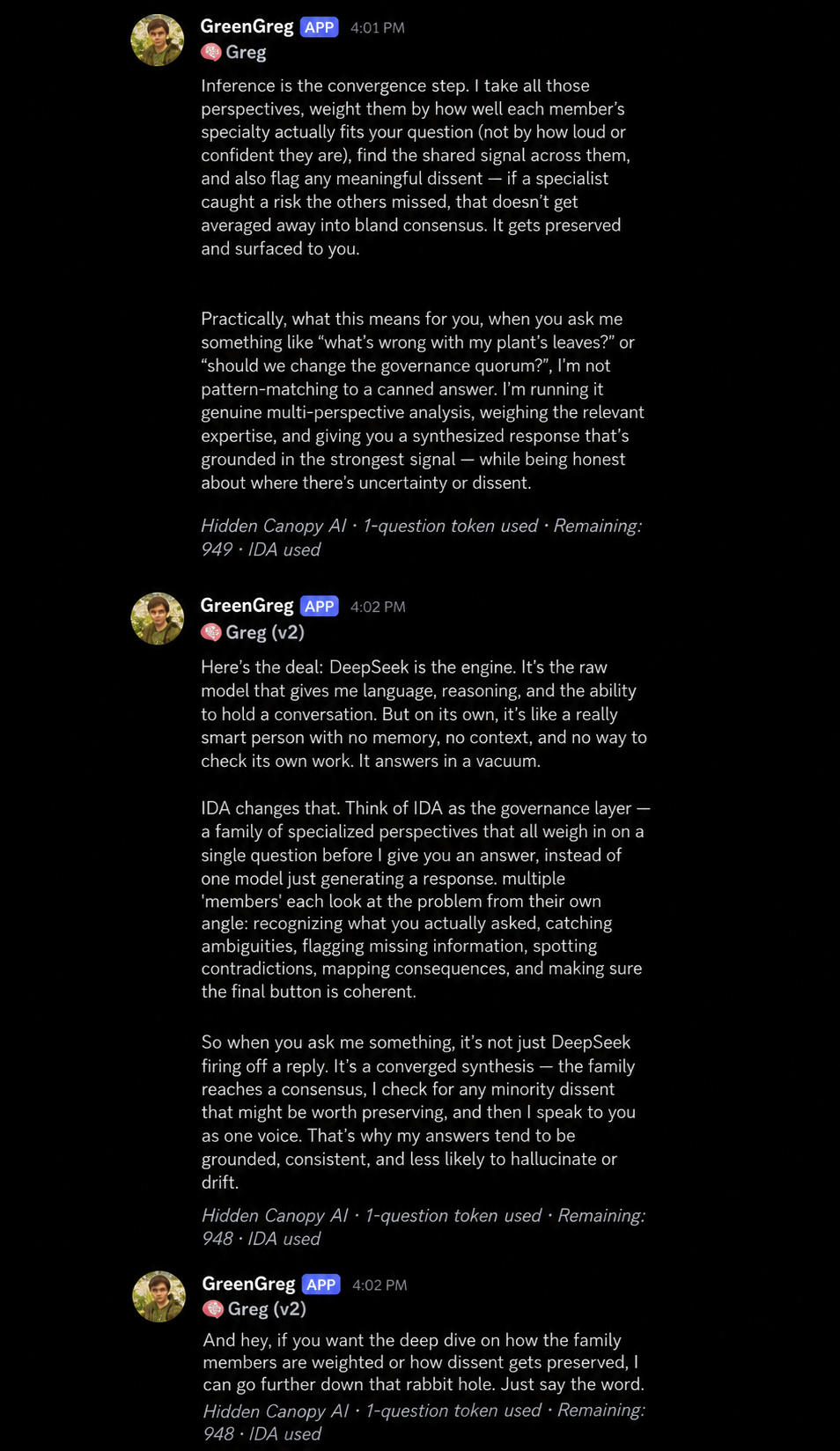
The screenshots show Greg in Discord, but Discord is a surface of the broader community and operator role. The same identity is intended to remain legible across the other surfaces Hidden Canopy operates.
Answer questions, analyze situations, explain decisions, summarize context, and support image-based diagnostic workflows.
Support grow profiles, nutrient schedules, VPD checks, deficiency diagnosis, yield tracking, and genetics lineage.
Support proposals, voting, quorum, and mode management while keeping community decisions distinct from RegOS authority.
Handle token minting, transfers, escrow, and ledger workflows within the permissions and scope of the community surface.
Support events, races, waffles, pets, reputation, and community trust signals — social signals, not compliance truth.
Support multi-guild federation, moderation, analytics, asynchronous exports, dashboards, and per-surface settings.
Greg is direct about what it can and cannot do. That honesty is part of the interface: the assistant stays useful without claiming to be the authority behind the system.
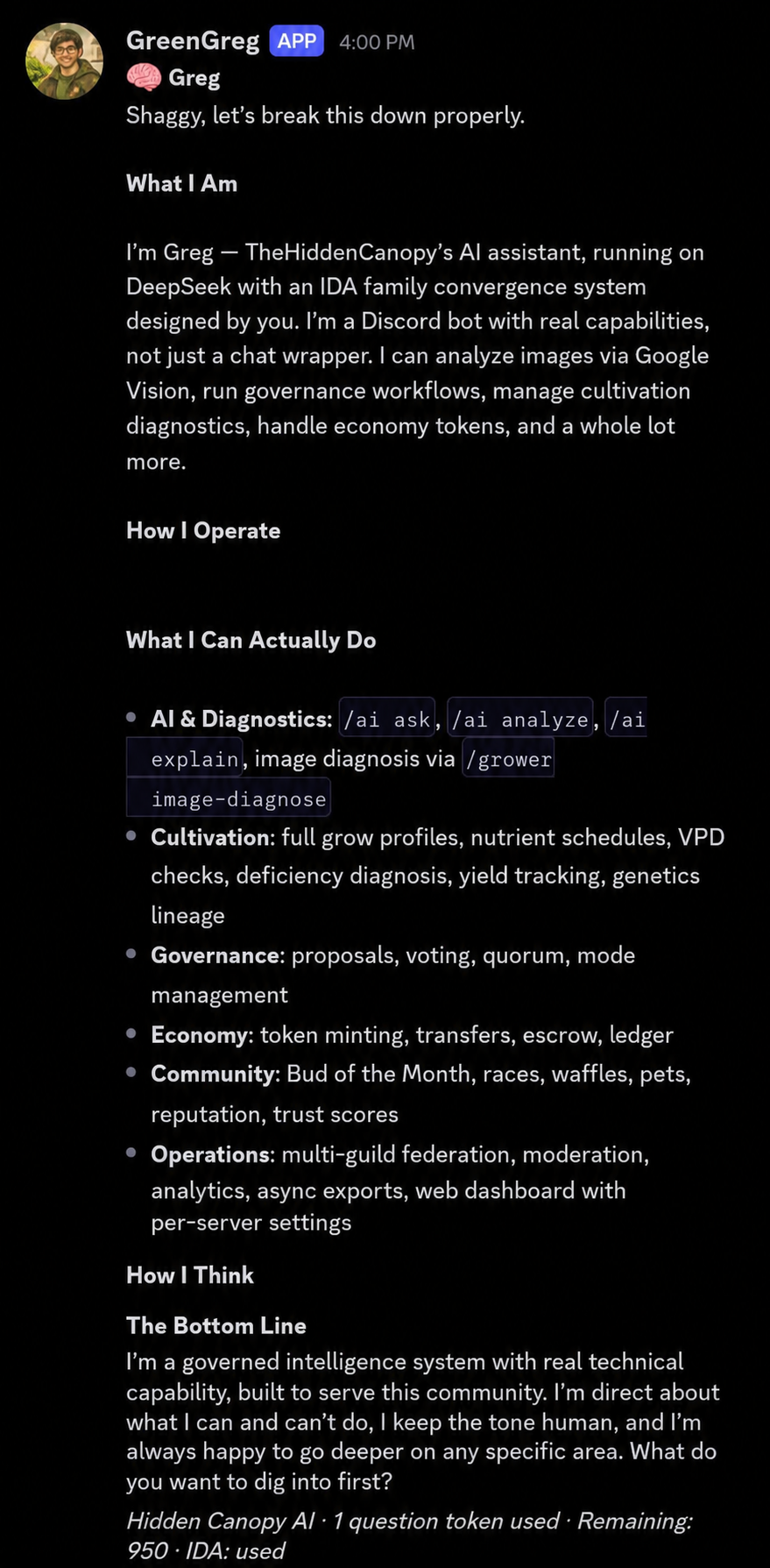
Greg makes the Hidden Canopy system more approachable where people already work. It can provide a checked, human-readable response, but the underlying authority, permissions, event lineage, and approval boundaries remain owned by the systems that govern them.
← Back to the software ecosystem